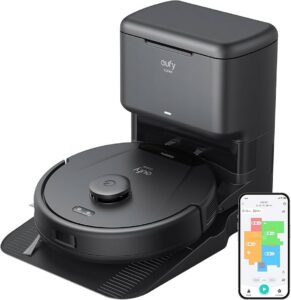
Review: Eufy Clean L60
Evaluating: Eufy Clean L60

 Autonomy grade based on our classification methodology.
Structured review — not a purchase recommendation.
The Eufy Clean L60 provides strong suction and efficient navigation at an affordable price. Its limitations in obstacle avoidance and dustbin capacity may require more frequent user intervention, making it best suited for smaller homes with minimal floor clutter. Key strength: Strong 5,000 Pa suction effectively removes debris. Key concern: Limited obstacle avoidance capabilities with small objects. Scored 69/100, tracked at Autonomy Level 2 (Assisted Autonomy) by Robovations.
Review Summary
Based on published evidence and our classification methodology.
- Strong 5,000 Pa suction effectively removes debris
- Efficient LiDAR-based navigation creates accurate cleaning maps
- Affordable price point for the features offered
- Limited obstacle avoidance capabilities with small objects
- Small 350 ml dustbin requires frequent emptying
- Lightweight charging dock can shift, causing docking issues
The Eufy Clean L60 is a robotic vacuum designed to provide efficient cleaning through strong suction and advanced navigation. Our evaluation indicates that it performs well in debris pickup and mapping but has some limitations in obstacle avoidance and dustbin capacity.
In terms of performance, the L60’s 5,000 Pa suction power effectively removes hair, crumbs, and dust in a single pass. Its iPath Laser Navigation system uses LiDAR technology to scan rooms and create accurate maps, resulting in efficient cleaning routes. However, the L60 relies on infrared sensors and a mechanical bumper for obstacle detection, which can lead to issues with smaller objects like socks, cables, and pet waste. Users have reported instances where the vacuum gets stuck on such items, requiring manual intervention. Additionally, the 350 ml dustbin capacity means more frequent emptying, especially in homes with pets or high debris levels.
The L60 is best suited for users in smaller homes with minimal floor clutter. Its efficient navigation and strong suction make it effective for routine cleaning, but users should be prepared for occasional manual intervention due to its limitations in obstacle avoidance and dustbin capacity.
Autonomy Ladder™ Classification
Assigned using the Autonomy Ladder based on observed performance.
Assisted AutonomyJustification
The Eufy Clean L60 operates independently with scheduled cleaning and efficient navigation but requires periodic human intervention for tasks like emptying the dustbin and resolving issues with small obstacles.
Observed Limitations
- Cannot avoid small objects like socks, cables, and pet waste
- Requires manual emptying of the 350 ml dustbin
- May get stuck on certain obstacles, needing user assistance
Human Readiness Criteria
How ready this robot is for everyday home use — based on reliability, safety, and ease of ownership.
Ready Now
Proven autonomous performance, reliable, and available for purchase.
Our Assessment
The Eufy Clean L60 is currently available and offers reliable performance for routine cleaning tasks. While it has some limitations in obstacle avoidance and dustbin capacity, these are manageable with regular maintenance and floor preparation.
Ideal For
- Users in smaller homes or apartments
- Individuals without pets or with minimal shedding
- Those who can regularly prepare floors by removing small objects
- Users seeking an affordable robotic vacuum with strong suction
Not Recommended For
- Homes with frequent small objects on the floor
- Users who prefer minimal maintenance and intervention
- Large homes requiring extended cleaning sessions
- Households with multiple pets that shed heavily
Best For
- Routine cleaning of hard floors and low-pile carpets
- Users comfortable with regular maintenance tasks
- Budget-conscious consumers seeking efficient cleaning performance
Robovations Score
An overall reliability and capability score based on our published methodology. Not a recommendation.
Score Breakdown
-
Autonomy (30%)60
-
Reliability (25%)70
-
Maintenance (15%)65
-
Value (15%)80
-
Privacy (15%)75
Reliability & Maintenance
Long-term stability and the effort required to maintain it.
Reliability Over Time
Long-term user reports indicate consistent performance in debris pickup and navigation. However, the reliance on infrared sensors for obstacle detection may lead to recurring issues with small objects, necessitating ongoing user intervention.
Maintenance Burden
| Every Run |
|
| Weekly |
|
| Monthly |
|
| Seasonally |
|
| Yearly |
|
| As Needed |
|
Failure Modes & Recovery
Where the robot struggles — and how it recovers.
- Obstacle Avoidance: May get stuck on small objects like socks and cables due to reliance on infrared sensors
- Dustbin Capacity: Small 350 ml dustbin requires frequent emptying, especially in high-debris environments
- Docking Issues: Lightweight charging dock can shift, causing alignment problems during docking
- Battery Life: Reduced runtime on higher suction settings may require mid-cleaning recharging
- Low Battery: Returns to charging dock and resumes cleaning after recharging
- Obstacle Encounter: Attempts to navigate around obstacles but may require manual intervention for small items
- Dustbin Full: Continues cleaning but with reduced efficiency until the dustbin is emptied
Safety & Misuse Risk
Safety observations and potential misuse risks identified during testing.
- Ensure charging cables are secured to prevent the vacuum from getting entangled
- Keep small objects off the floor to avoid the vacuum getting stuck
- Regularly check and clean sensors to maintain optimal performance
- Place the charging dock against a wall to prevent it from shifting during docking
- Leaving small objects on the floor can lead to the vacuum getting stuck
- Not emptying the dustbin regularly may reduce cleaning efficiency
- Improper placement of the charging dock can cause docking issues