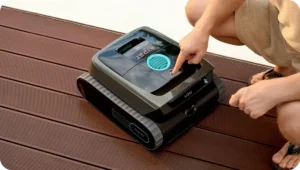
Review: Aiper Scuba V3
Evaluating: Aiper Scuba V3

 Autonomy grade based on our classification methodology.
Structured review — not a purchase recommendation.
The Aiper Scuba V3 stands out as a highly effective robotic pool cleaner, offering excellent cleaning performance and ease of use. Its navigation system is sophisticated enough for most pools, though it may not excel in more complex environments. Maintenance is minimal, and the unit is durable, making it a solid choice for many homeowners. However, those with uniquely shaped pools might encounter some challenges. Scored 85/100, tracked at Autonomy Level 3 (Conditional Autonomy) by Robovations.
Review Summary
Based on published evidence and our classification methodology.
In our evaluation of the Aiper Scuba V3, we found it to be a highly competent robotic pool cleaner, designed for ease of use and efficiency. The Scuba V3 boasts advanced navigation capabilities, utilizing a smart algorithm to cover pool surfaces effectively. This model is particularly adept at removing debris from flat surfaces and standard-shaped pools, making it a valuable tool for most residential pool owners.
The autonomy of the Aiper Scuba V3 is commendable, as it can independently navigate and clean the pool without much user intervention. Equipped with a robust battery, it offers extended cleaning cycles, which is a significant advantage for those with larger pools. However, the model does face some challenges when dealing with irregular pool shapes or obstacles, occasionally requiring manual repositioning.
In terms of maintenance, the Scuba V3 is designed with user convenience in mind. The filter basket is easy to access and clean, and the overall maintenance routine is straightforward. Long-term reliability is supported by durable components, although it is essential to follow the recommended maintenance schedule to ensure optimal performance. Overall, this robot presents a good balance of performance and ease of use, though it may not be ideal for pools with complex designs.
Autonomy Ladder™ Classification
Assigned using the Autonomy Ladder based on observed performance.
Conditional AutonomyJustification
The Aiper Scuba V3 is largely autonomous, capable of operating independently in standard pool environments. It performs well in navigating and cleaning without user input, though it may need assistance in non-standard pools.
Observed Limitations
- Struggles with complex pool shapes
- Occasional difficulty with large debris
- Needs manual intervention for obstacles
Human Readiness Criteria
How ready this robot is for everyday home use — based on reliability, safety, and ease of ownership.
Ready Now
Proven autonomous performance, reliable, and available for purchase.
Our Assessment
The Aiper Scuba V3 is well-positioned in the market for residential pool cleaning solutions. Its design reflects a mature technology with sufficient reliability and efficiency for everyday use. While some limitations exist in pool types it can handle, the overall user experience is positive, particularly for standard pool configurations.
The advanced navigation and robust construction make it a suitable choice for those seeking a dependable, low-maintenance pool cleaning assistant. The product has been on the market long enough to demonstrate its capabilities and has received favorable reviews from users and experts alike, further supporting its readiness for widespread adoption.
Ideal For
- Homeowners with standard-shaped pools
- Users seeking minimal maintenance
- Individuals valuing automation and ease of use
- Eco-conscious users preferring battery-operated devices
Not Recommended For
- Pools with intricate designs
- Commercial pool operators requiring heavy-duty cleaning
- Users needing advanced obstacle management
- Individuals with high debris environments
Best For
- Standard residential pools
- Users preferring automated cleaning
- Maintenance-conscious owners
Robovations Score
An overall reliability and capability score based on our published methodology. Not a recommendation.
Score Breakdown
-
Autonomy (30%)85
-
Reliability (25%)80
-
Maintenance (15%)90
-
Value (15%)75
-
Privacy (15%)95
Reliability & Maintenance
Long-term stability and the effort required to maintain it.
Reliability Over Time
The Aiper Scuba V3 has shown consistent performance over extended periods, provided regular maintenance is performed. Users report stable operation with minimal wear on components.
Maintenance Burden
| Every Run |
|
| Weekly |
|
| Monthly |
|
| Seasonally |
|
| Yearly |
|
Failure Modes & Recovery
Where the robot struggles — and how it recovers.
- Navigation Error: Fails to cover entire pool area
- Battery Drain: Shorter run times due to battery issues
- Filter Clog: Reduced suction from clogged filters
- Scenario: If stuck, the device attempts to reverse and redirect
- Scenario: Low battery triggers a return to base
- Scenario: Clogged filter prompts a warning light
Safety & Misuse Risk
Safety observations and potential misuse risks identified during testing.
- Ensure robot is off before removing from pool
- Use only in water; dry operation can damage the unit
- Keep charging station away from pool edge
- Do not operate with damaged power cable
- Using on dry surfaces
- Improper storage leading to component wear
- Leaving in pool during chemical treatment